If you've spent the last two years adding productivity tools to your business — a ticketing app here, a project management tool there, a reporting dashboard somewhere else — and your operations still feel chaotic, you're not alone.
The tools aren't failing you. The approach is.
In 2026, the businesses gaining real operational leverage aren't the ones with the most apps. They're the ones that replaced fragmented tools with a single, AI-powered operational system built around how they actually work.
This post breaks down exactly what that means, why it matters now more than ever, and what separates businesses that are scaling cleanly from those still stuck chasing updates over WhatsApp.
The Real Problem Isn't Your Team — It's Your Infrastructure
Most growing businesses reach a breaking point somewhere between 20 and 50 employees. The informal coordination that worked when the team was small—shared inboxes, WhatsApp groups, and Google Sheets—starts to collapse under the weight of volume.
Requests get lost. Approvals sit unanswered. No one knows who owns what. Managers spend half their day chasing status updates instead of making decisions.
This is not a discipline problem. It's an infrastructure problem. And the solution isn't more meetings or stricter processes. It's a system that makes the right information visible to the right people automatically — and handles the manual overhead so your team doesn't have to.
What Is an AI-Powered Operational System?
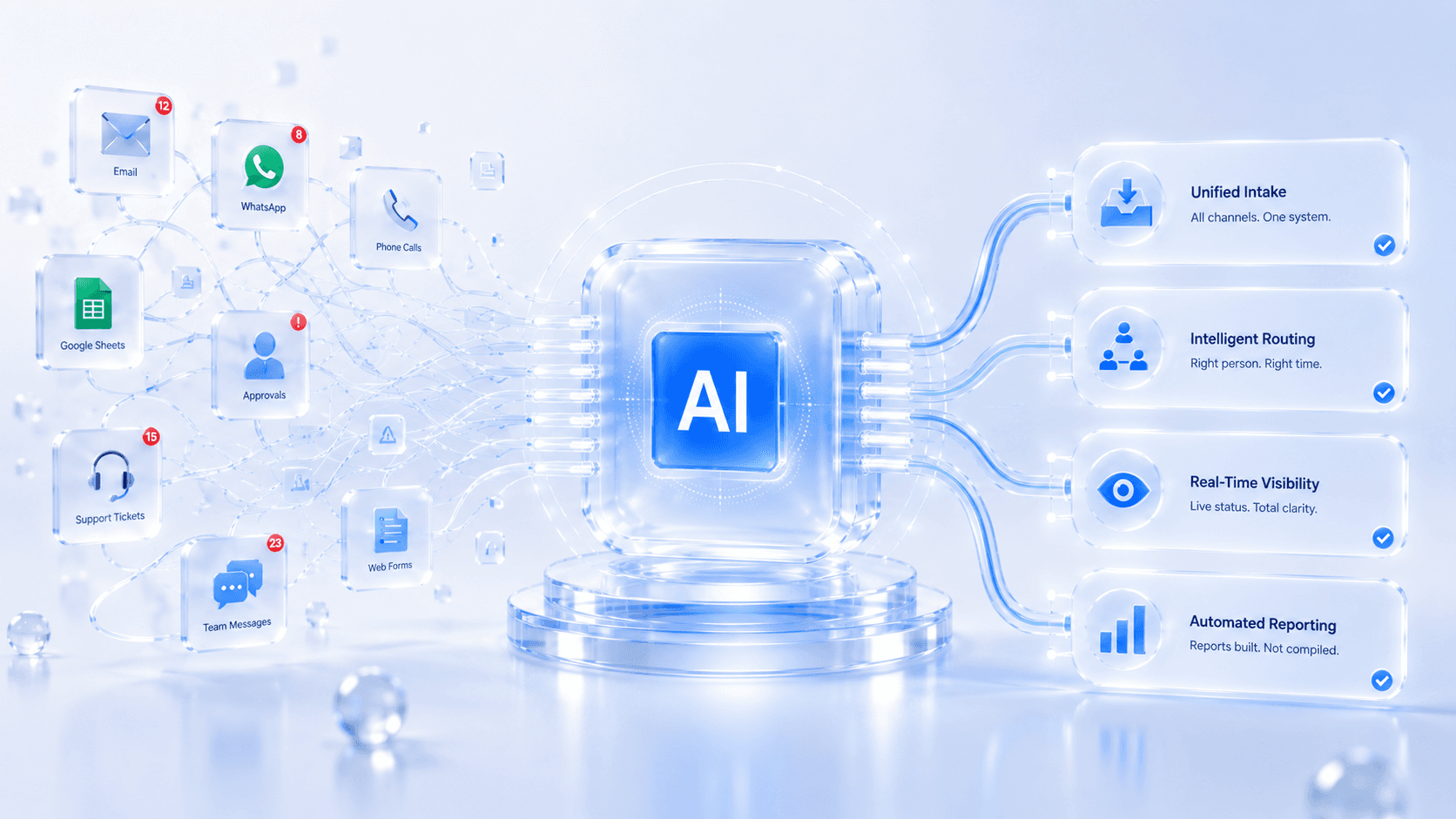
An AI-powered operational system is not a SaaS subscription or a project management tool. It's the custom infrastructure that connects the following:
— How work enters your business (email, forms, WhatsApp, phone)
— How it gets classified and routed (to the right person, team, or queue)
— How it's tracked and reported (in real time, without manual input)
— How it escalates when something goes wrong (automatically, before it's too late)
The AI layer isn't decorative. It routes requests based on role and workload, writes handoff summaries so teams don't need to, flags SLA risks before they breach, and generates operational reports without anyone touching a spreadsheet.
Combined, these functions eliminate the manual overhead that most growing businesses are quietly drowning in.
Why 2026 Is the Year This Becomes Non-Negotiable
According to recent industry analysis, hyperautomation — the combination of AI, workflow automation, and intelligent routing into one connected system — is now the dominant operational trend across logistics, healthcare, field operations, and professional services.
The businesses winning in 2026 didn't install AI as a side feature. They rebuilt their operations around it.
That shift is creating a compounding gap. Companies with proper operational infrastructure are handling more volume with the same headcount. Companies without it are hiring more people to manage the same chaos.
The question is no longer whether to build an operational system. It's whether you build it now or after the cost of not having one becomes too obvious to ignore.
What This Looks Like in Practice
Here's a concrete example. A regional support operation with 35 staff and 400+ weekly requests was managing everything through a shared email inbox and a Google Sheet.
One manager manually read, sorted, and assigned every incoming request. The weekly ops report took four hours every Friday. SLA breaches were discovered when clients complained.
After deploying a custom GenRes operational system:
— All requests are auto-classified and routed on arrival
— Live dashboard showing all 35 staff, all statuses, in real time
— Weekly report auto-generated every Monday morning
— Zero missed SLAs in the first 90 days
Same team. No new hires. Completely different operations.
The 4 Pillars Every Operational System Needs
Whether you're in logistics, healthcare administration, field operations, or professional services, a properly built operational system needs four things:
1. Unified intake — all request channels feeding into one system, regardless of source.
2. Intelligent routing — tasks assigned automatically by role, team, and workload, not manually.
3. Real-time visibility — the right stakeholders seeing the right information without asking for it.
4. Automated reporting — weekly and monthly operational reports generated by the system, not a person.
Without all four, you still have gaps. With all four operations run.
How to Know If You Need One
Answer these five questions honestly:
1. Can you see the status of every open request right now without asking anyone?
2. Do you know who has the highest workload on your team today?
3. Is your weekly ops report generated automatically or compiled manually?
4. Are SLA breaches discovered before or after clients complain?
5. Do requests ever go missing between channels?
If any answer is no, your business needs an operational system, not another productivity app.
At GenRes, we start with a free operational audit: a 60-minute session that maps your current workflow, identifies your highest-friction points, and shows you exactly what a custom system would look like for your team. No commitment. No pitch. Just clarity.