Growth is supposed to be the goal. But for most operations teams, growth mostly means more volume on a system that was already straining.
More requests. More coordination. More managers are needed. More manual work.
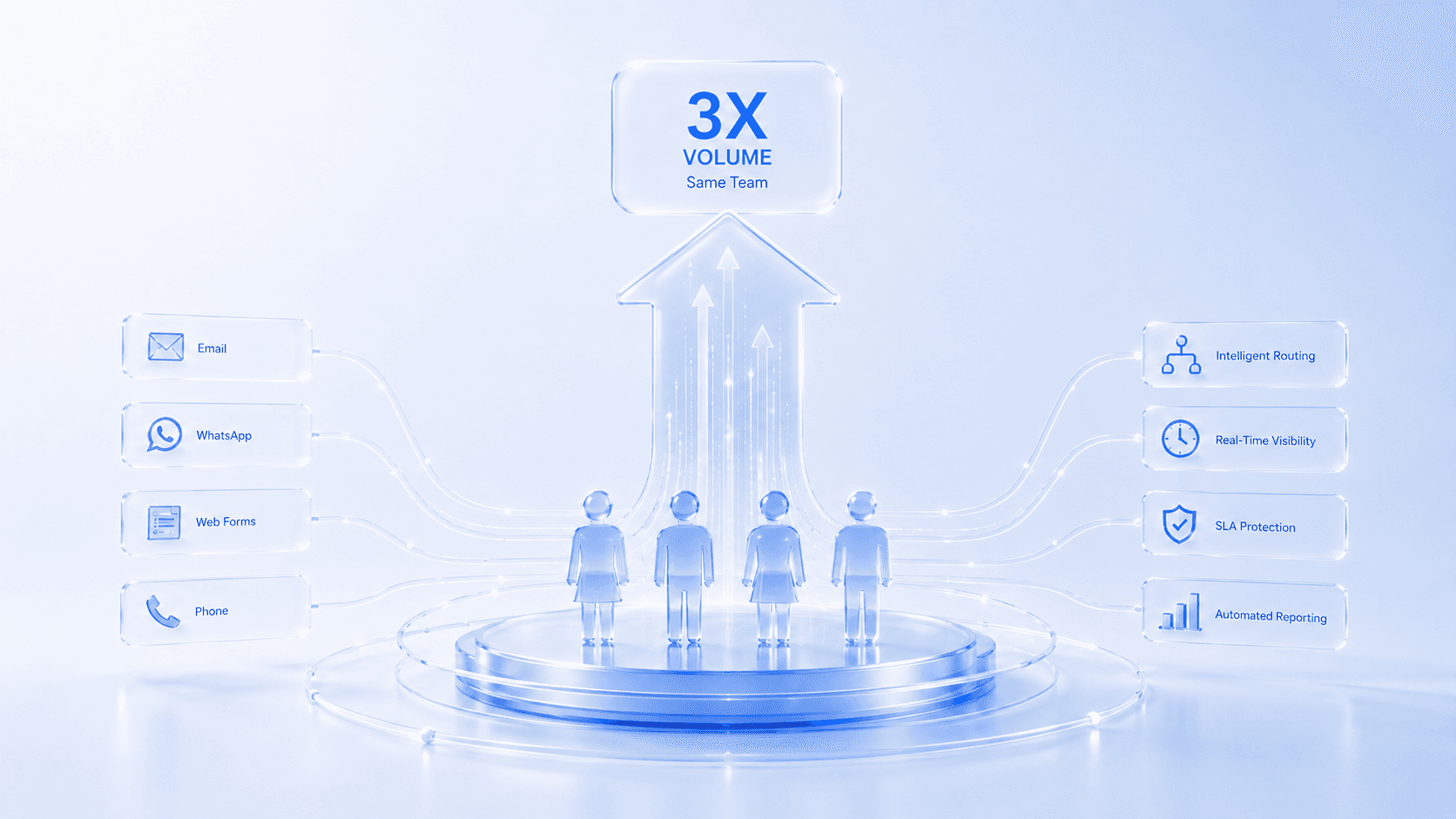
The businesses that scale cleanly — handling 3x the volume without 3x the headcount — have something in common. They built their operational infrastructure before the growth hit, not in response to it.
This post explains how they did it and what it takes to replicate.
The Headcount Trap
When operations start to strain under volume, the first instinct is to hire. More coordinators. More supervisors. More people to manage the flow.
The problem is that hiring into a broken system just scales the broken system. New team members learn the same workarounds. The manual coordination overhead per person stays roughly constant. You've bought capacity, but the efficiency ratio hasn't changed.
The businesses that break this pattern do it by changing the ratio — handling more volume per person by removing the coordination overhead from the equation entirely.
What Scaling Operations Actually Require
Scaling operations without scaling headcount proportionally requires three things:
1. Eliminating manual coordination tasks
Every hour a team member spends sorting, routing, updating, or compiling is an hour not spent on the work itself. Operational systems that automate these tasks directly increase per-person throughput.
2. Making the right information visible automatically
At scale, managers can't personally track every request. The system needs to surface what requires attention — SLA risks, capacity imbalances, stalled requests — without managers having to ask for it.
3. Designing for exception handling, not just standard flows
Standard workflows are easy to automate. What breaks operational capacity at scale are exceptions—the requests that don't fit the standard path and require human judgment. A well-designed operational system handles the 80% automatically and routes exceptions to the right human with context, not noise.
The Role of AI in Operational Scaling
AI is what makes the arithmetic of scaling operations actually work.
Without AI, an operations system can automate fixed-rule tasks. Route this type of request to this team. Send a reminder after 24 hours. Generate a report template.
With AI, the system makes contextual decisions. Route this request to the team member with lowest current load and highest match to request type. Escalate this ticket because its complexity profile suggests it will miss the SLA at the current velocity. Flag this pattern in the weekly report because it represents a recurring bottleneck.
The difference in throughput is significant. An AI-assisted routing system doesn't just move faster than manual routing — it moves more accurately. Fewer misassignments. Fewer requeues. Fewer exceptions that become escalations.
Real Numbers: What Operational Scaling Looks Like in Practice
A logistics coordination team managing 300 weekly requests was looking at its third consecutive quarter of volume growth and preparing to hire two additional coordinators.
Instead, they deployed a custom GenRes operational system over six weeks.
Six months later: the same team was handling 480 weekly requests—60% more volume—with no additional hires. The coordinators previously spending 2 hours daily on manual routing and status updates were spending that time on exception handling and client communication instead.
The system didn't replace the team. It redirected their capacity from coordination to value-generating work.
How to Prepare Your Operations for Scale
The best time to build operational infrastructure is before you need it. The second-best time is now.
The preparation steps are straightforward:
Document your current request flows, including every channel requests arrive
Define clear ownership: every request type should have an unambiguous responsible team
Define your SLAs: what does on-time look like for each category of work?
Identify your three highest-friction points: where does work stall or go missing most often?
These four inputs are what GenRes uses in the Operational Audit phase to design a system that fits your specific workflow. The audit takes 60 minutes. The clarity it provides is the foundation for everything that follows.